Quick Nav
- Key Clearance Requirements at a Glance
- Primary Radio Contact Procedures
- Mandatory Pre-Arrival Documentation
- Post-Arrival Verification Steps
- Step-by-Step Clearance Execution for a 42-Foot Sloop
Key Clearance Requirements at a Glance
I examine clearance procedures across ports to streamline yacht entry processes into Trinidad and Tobago. Monitoring reports show that maritime authorities frequently flag digital pre-arrival steps as the most commonly missed requirements by incoming cruisers. Consequently, prioritizing the TTravel Pass and PCR testing windows establishes a certified foundation for legal entry.
The testing certificates must align with a strict 72-hour maximum validity window prior to arrival.
Vessels arriving without a pre-approved TTravel Pass face mandatory quarantine at anchorage. This administrative delay restricts crew movement and halts all maintenance schedules. Captains must secure this approval before crossing into territorial waters.
Caution: Failure to secure the TTravel Pass before entering territorial waters triggers immediate isolation protocols.
Initial contact relies on VHF Channel 16 and SSB 2182kHz. A Float Plan must accompany all navigation documentation to ensure port authorities can track incoming vessels accurately.
Primary Radio Contact Procedures
Stakeholder feedback indicates that direct hails to the TTCG: Trinidad and Tobago Coast Guard frequently fail due to line-of-sight terrain blocking on the northern approach. VHF reception quality varies significantly depending on the vessel's approach angle through the Bocas del Dragón. Navigating these narrow straits creates radio shadows that block standard transmission frequencies. Captains often waste critical hours attempting to establish direct contact with port officials.
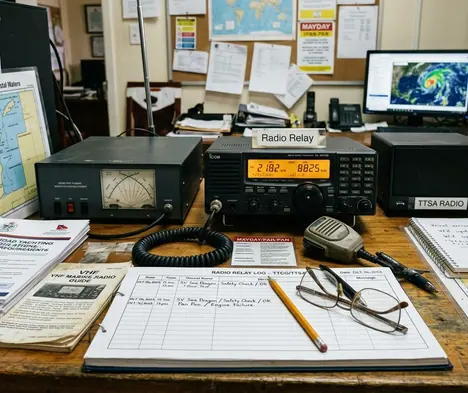
To mitigate this systemic challenge, North Post Radio acts as the designated maritime relay. This routing ensures continuous communication tracking across the northern coastline.
VHF Channel 16 serves as the initial hailing frequency for short-range contact. SSB 2182kHz provides secondary long-range confirmation for vessels approaching from deeper offshore positions.
Expert Tip: Hail North Post Radio rather than attempting direct Coast Guard contact when navigating the northern channels.
Mandatory Pre-Arrival Documentation
The documentation workflow explicitly separates the Float Plan from the TTravel Pass. Captains must recognize these submissions are processed by distinct maritime and health departments. Combining these documents into a single email or submission portal guarantees administrative rejection.
The TTravel Pass functions as the official online entry application. The Float Plan records the intended route and crew manifest. While these documentation protocols represent the optimal baseline for standard recreational vessels, commercial or chartered entries require supplementary customs declarations not covered in this analysis.
Main Point: Submit health and maritime documents through their respective independent channels to prevent processing delays.
Upon successful processing, captains receive authorization to proceed toward the Single harmonised Immigration clearance form upon landfall.
Post-Arrival Verification Steps
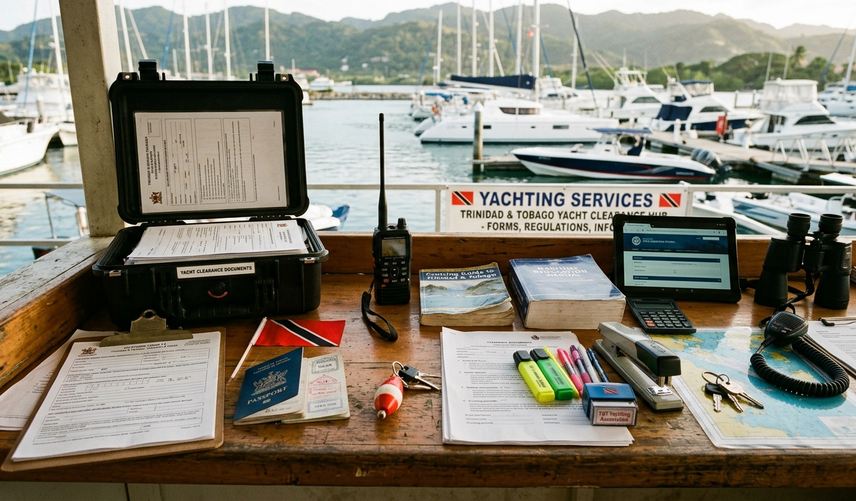
Once a vessel secures its anchorage or is hauled out on the hard, health verification protocols commence. YSATT coordinates with the TTCG: Trinidad and Tobago Coast Guard for compliance verification. This joint effort ensures that incoming crews meet all local health mandates without overwhelming port facilities.
Pediatric testing is scheduled within a 24 to 72-hour window after landing. Local yachting associations coordinate directly with health officials to conduct marina-based testing. This prevents families from needing to secure specialized transport to inland clinics.
One catch exists regarding this timeline—the three-day pediatric testing window strictly applies to unvaccinated minors. Fully vaccinated children follow standard adult clearance protocols.
Step-by-Step Clearance Execution for a 42-Foot Sloop
This chronological timeline provides a concrete execution model for a standard 42-foot sloop entering the jurisdiction.
- Day -4: Submit the TTravel Pass application. Attach all crew PCR results, ensuring the health officials collected the samples within the 72-hour maximum validity window.
- Day -1: File the Float Plan detailing the intended route. Hail North Post Radio on VHF Channel 16 to confirm the vessel's approach and establish the communication relay.
- Arrival Day: Navigate through the Bocas del Dragón. Proceed directly to the designated anchorage for the TTCG: Trinidad and Tobago Coast Guard inspection. Do not disembark or attempt to move items to a bonded warehouse until physical clearance is granted.
- Day +2: Schedule pediatric testing for any unvaccinated minors aboard. Complete the Single harmonised Immigration clearance form at the port facility.