Yacht safety in Trinidad begins with a disciplined radio routine, not a gadget stack. I treat Chaguaramas as a communications basin with very clear habits: check the morning net, keep emergency watch alive after dark, and leave enough itinerary detail ashore that someone can make a useful call if the boat does not appear where it should.
That sounds simple until a crew leaves the main anchorage, rounds toward the North Coast, and discovers that a mobile phone has turned into a dead rectangle. Vessels relying solely on mobile phones for emergency contact during North Coast transits often experience total communication blackouts. VHF procedure is not old-fashioned here; it is the working layer that still reaches the right people.
Quick Nav
- What VHF Procedures Protect Yachts in Trinidad?
- Core Security Practices
- VHF Channel Usage and Monitoring Schedule
- Creating and Submitting a Float Plan
- Coordination with Trinidad Authorities
What VHF Procedures Protect Yachts in Trinidad?
The primary procedure is a two-channel rhythm. Use VHF Channel 68 for the daily cruisers net between 8:00 a.m. and 8:30 a.m. AST, then maintain readiness for Channel 16 emergency traffic, especially at night when Coast Guard and CDA Police monitoring takes over from 18:00 to 06:00 AST.
When establishing the baseline for Chaguaramas, cellular-based tracking apps were considered and then ruled out as the main recommendation because signal coverage drops away in the very places where cruisers tend to need help. The better comparison is not app versus no app. It is app as convenience versus VHF as a shared maritime channel with known listeners, known times, and local habit behind it.
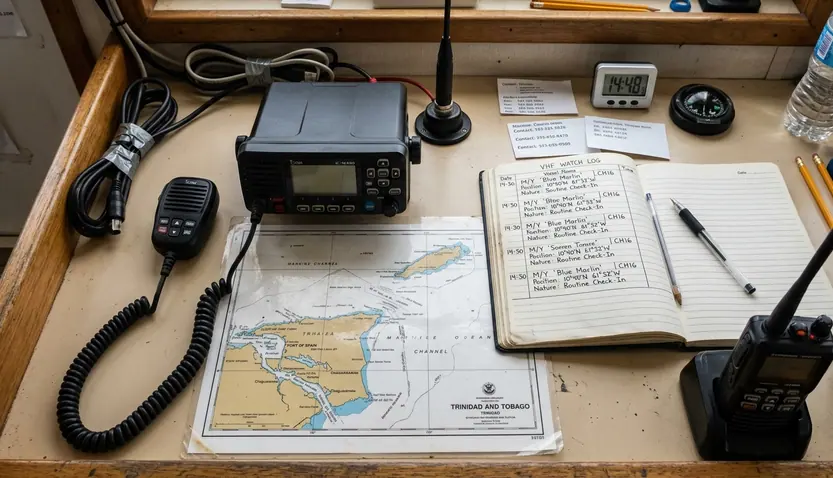
The community need is practical: visiting yachts anchor, move, haul out, clear in, repair, and sometimes sit on the hard while crews travel. The program response is equally practical. Channel 68 carries the morning safety updates, weather notes, and vessel roll calls. Channel 16 remains the emergency channel, with nighttime attention from the Coast Guard and CDA Police. The key local contacts a skipper should carry are CDA Police, Carenage Police, and YSATT.
Main Point: For a yacht in Trinidad and Tobago, the communication baseline is not continuous chatter. It is a fixed morning check-in on Channel 68 and a disciplined emergency watch on Channel 16.
That pattern creates measured operational value without pretending to solve every security problem. A missing yacht with a filed route, a last heard radio contact, and an expected return window gives local responders a narrower search problem than a yacht whose only trace is a silent phone.
Core Security Practices
The core practices fit on a short watch bill, which is why they work. Monitor the designated VHF channels at the specified times. File a float plan before each itinerary segment. Maintain current contact lists for CDA Police and the TTCG: Trinidad and Tobago Coast Guard, with direct landline numbers for the Carenage Police station kept alongside the standard VHF channels.
Marine incident logs from 2021 through 2022 pointed toward one recurring weakness: vessels without pre-filed itineraries were harder to verify and harder to locate quickly. That finding does not require a dramatic interpretation. It means the paperwork and the radio schedule have to meet before the boat leaves the anchorage.
The three practices to make routine
- Radio watch: Listen to the Channel 68 cruisers net from 8:00 a.m. to 8:30 a.m. AST, and keep Channel 16 available for emergency traffic while underway.
- Float plan: File the plan 24 to 48 hours before each itinerary segment departure, not once for an entire season.
- Contact list: Carry CDA Police, Carenage Police landline details, YSATT contact information, and Coast Guard VHF procedures in a place the watchkeeper can reach quickly.
These practices sit beside formal clearance procedures, not inside them. The Single harmonised Immigration clearance form answers a government entry question. A float plan answers a safety question: where should someone start looking if the boat does not report back?
Caution: Do not let a marina Wi-Fi group chat become the only record of a passage plan. It may help socially, but it is not a substitute for a filed route, contact numbers, and a VHF watch.
VHF Channel Usage and Monitoring Schedule
Before the current schedule became common practice, radio use among visiting yachts could be uneven: some crews listened only when moving, some monitored informally at anchor, and others treated the handheld as a tender tool. During engagement with the Chaguaramas cruising community, the morning broadcast window was synchronized with local marine patrol shift changes so departing and arriving officers had overlapping awareness.
The outcome is a plain schedule that can be written inside the logbook cover.
Channel 68: morning safety traffic
VHF Channel 68 is used for a 30-minute window starting at 8:00 a.m. AST. Expect weather, security updates, and vessel roll calls. This is the place to build local awareness before a fuel run, a haul-out movement, a North Coast departure, or a marina transfer.
One catch matters for Scotland Bay. Channel 68 broadcasts frequently fail to reach vessels anchored beyond the Scotland Bay ridge because terrain masking can be severe. For this narrow security topic, radio reach should be read as line-of-sight coverage, not as an assurance that every anchorage hears every transmission.
Channel 16: emergency and underway watch
Channel 16 requires continuous dual-watch monitoring while underway in Trinidadian waters. At night, emergency monitoring shifts to Channel 16 and is actively monitored by the Coast Guard and CDA Police from 18:00 to 06:00 AST. That does not make casual traffic appropriate. Keep Channel 16 clear for distress, urgency, safety, and response coordination.
The comparison is useful: Channel 68 is the scheduled local room; Channel 16 is the emergency door. A skipper who blurs the two makes both less effective.
Expert Tip: If your fixed set supports dual watch, leave Channel 16 active and scan Channel 68 during the morning net. If you only have one reliable receiver, prioritize Channel 16 when underway and arrange a second listener for the morning net when practical.
Creating and Submitting a Float Plan
Stakeholder feedback indicates that float plans work best when they reach people close enough to conduct a quick visual check. That is why the distribution protocol includes local marina offices and YSATT rather than relying solely on military authorities. A marina desk may know that your dinghy is still tied astern. YSATT may know which boats planned the same movement. Those details matter before a formal escalation.
The systemic challenge is specificity. A note saying going north for a few days is too soft to support a response. A usable plan records the intended route, stops, exact GPS coordinates of intended anchorages, crew list, communications channels, and a return window spanning no more than 4 hours.
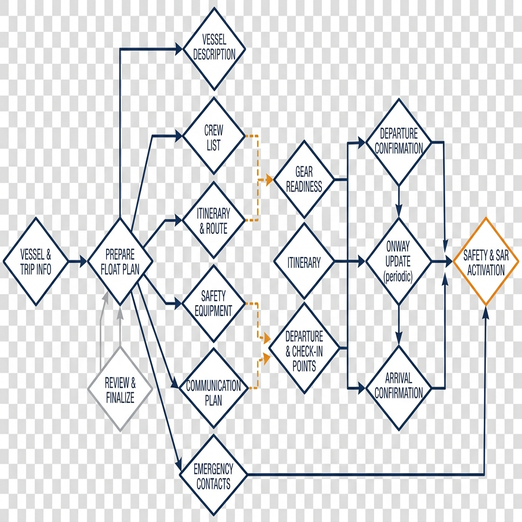
Pre-Departure Float Plan Checklist
- Record vessel name, registration, and MMSI number.
- List all crew members and passport numbers.
- Define exact departure time and estimated arrival window within a 4-hour margin.
- Specify primary and secondary VHF monitoring channels.
- Document the intended route, planned stops, and exact GPS coordinates for anchorages.
- Share copies with YSATT and the relevant local marina office.
- File the plan 24 to 48 hours before departure.
- Update the plan by VHF or telephone within 2 to 3 hours if the itinerary changes.
Small administrative delays still count as changes. If a crew postpones departure because a part is held in a Bonded warehouse, or because the boat remains on the hard for another day, the float plan should be updated rather than left to expire quietly.
The pathway forward is repetition. Make the float plan part of the same departure sequence as checking fuel, charging handhelds, and confirming weather. Once it becomes a habit, it stops feeling like paperwork and starts behaving like a safety instrument.
Coordination with Trinidad Authorities
Coordination depends on jurisdiction. CDA Police maintain primary jurisdiction for the immediate Chaguaramas anchorage basin and respond to non-life-threatening security calls. The Coast Guard assumes primary response duties for offshore incidents and life-threatening emergencies broadcast on Channel 16.
Carenage Police contact details should still be carried directly, not remembered vaguely as something the marina might have. Contact lists must include direct landline numbers for the Carenage Police station alongside standard VHF channels. Response times from the Carenage Police vary significantly depending on whether the incident occurs within the main marina basin or at outer anchorages like Monos Island, so the first report should state the exact location, nature of the incident, and whether anyone is in immediate danger.
Choosing the first call
- Security concern in the Chaguaramas basin: Contact CDA Police and keep Channel 16 available if the situation escalates.
- Offshore emergency or threat to life: Call on Channel 16 for Coast Guard response.
- Incident near Carenage or involving shore-side follow-up: Use the carried Carenage Police landline details and record the time of contact in the vessel log.
- Community verification: Notify YSATT or the marina office holding the float plan so they can confirm last known movements.
Jurisdictional boundaries were mapped into these guidelines to prevent cruisers from hailing the wrong agency during the first minutes of an incident. That first call often shapes the rest of the response. A clean report beats a dramatic one: vessel name, position, persons aboard, problem, assistance needed, and next monitoring channel.
Worked departure example
A skipper planning to move from Chaguaramas to a North Coast anchorage on Friday can copy this sequence. On Wednesday morning, complete the float plan with vessel name, registration, MMSI, crew passports, route, GPS position for the intended anchorage, and a return window of 14:00 to 18:00 on Sunday. Send copies to YSATT and the marina office. On Friday at 8:00 a.m., listen to the Channel 68 cruisers net, note any security or weather update, and confirm that the fixed VHF is set for dual watch with Channel 16 active. Before departure, place the CDA Police number, Carenage Police landline, and Coast Guard Channel 16 procedure beside the logbook. If the yacht diverts to Monos Island at 11:30, call or radio the update by 14:30 with the new GPS position and revised return window.