Quick Nav
- Definition of a Convoy Request
- Key Takeaways for Filing
- Eligibility Criteria and Scope
- Required Documentation Standards
- Submission Workflow
- Operational Execution and Limits
Definition of a Convoy Request
A convoy request is a formal application to coordinate group transit with regional maritime authorities for the Grenada-Trinidad passage, with synchronized departure windows, named participating vessels, and agreed communication protocols. It is not a casual note passed between skippers at anchor.
The practical reason for the procedure is simple: ad-hoc buddy boating leaves too many gaps. A group may leave together, separate in darkness, change channels, or fail to report a delay. Maritime coordinators built the convoy protocol to move that behavior into a trackable system, so regional security assets can understand the fleet as a single movement rather than a loose string of independent yachts.
The route context matters. The passage commonly discussed in convoy planning covers the 85 to 90 nautical mile run between the Hibiscus gas platform and the Bocas del Dragon. That water is short enough to invite overnight recreational passages, but long enough for weather, radio range, speed differences, and security assessments to change the character of the transit.
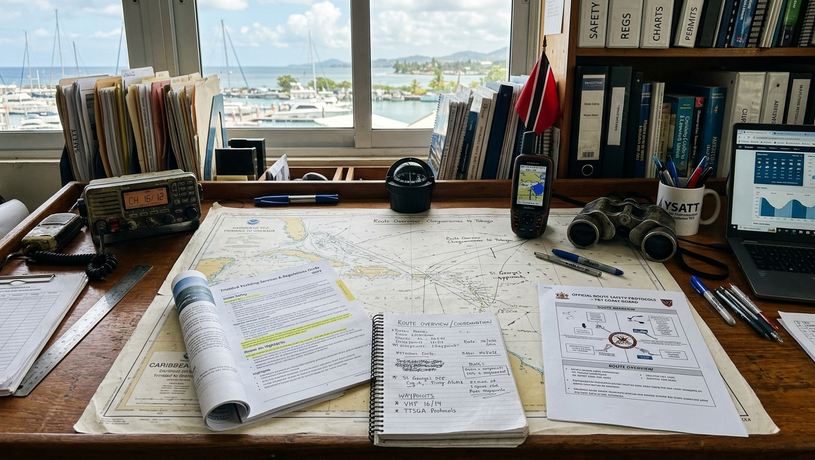
What the request actually coordinates
The request establishes who is moving, when they are leaving, what equipment they will use to communicate, and how the group should respond if a vessel falls behind. VHF communication protocols normally begin with DSC, Digital Selective Calling, for initial fleet synchronization before vessels settle into the assigned working channel.
Main Point: A convoy request is a coordination instrument. It does not turn the passage into a private escorted corridor, and it does not replace vessel readiness, clearance compliance, or skipper judgment.
Key Takeaways for Filing
The filing window drives the whole process. Requests should be submitted through designated official channels 72 to 96 hours before the intended departure time. That lead time gives the TTCG: Trinidad and Tobago Coast Guard and port-side coordinators room to review vessel compliance, confirm the route context, and consider current security reporting.
Security assessments are not based on marina rumor or a single radio call. The convoy review uses piracy threat information from the preceding 14 to 21 days, which is long enough to catch patterns but recent enough to matter for a yacht planning a specific night at sea.
The filing essentials
- Departure timing: Submit the request 72 to 96 hours before the planned departure, not on the afternoon of departure.
- Vessel identity: Include registration details, tonnage, vessel name, and call sign or MMSI information where applicable.
- Crew accountability: Provide a complete crew manifest with passport details and emergency contacts.
- Communications readiness: Verify VHF capability, DSC function, and the agreed inter-ship working frequency.
- Compliance status: Hold valid departure clearance and resolve any clearance or equipment issues before requesting a slot.
Program evaluation revealed a pattern that experienced clearance officers will recognize immediately: incomplete crew manifests and expired EPIRB registration are not small clerical defects. They can stop a request because they create uncertainty at the exact point where the system is trying to remove it.
Caution: Do not file a convoy request as a placeholder while documents are still missing. If the crew list changes, the EPIRB record is out of date, or the clearance certificate is not issued, the application may need to be corrected before it can be treated as operational.
Pre-Departure Convoy Preparation Checklist
- Verify e-SeaClear outbound clearance is approved and printed.
- Submit digital crew manifest and vessel particulars 72 to 96 hours prior to departure.
- Test VHF DSC functionality and confirm MMSI numbers with convoy leads.
- Check EPIRB registration status before the request is filed.
- Confirm that the marine insurance policy covers the intended Caribbean route.
- Record the assigned working channel and maintain Channel 16 watch procedures.
Eligibility Criteria and Scope
Eligibility begins with clearance. A vessel must hold valid Trinidad and Tobago or Grenada port clearance documentation before it can be considered for coordinated transit. In practice, that includes a valid e-SeaClear outbound clearance certificate from the port of departure.
The scope is intentionally narrow. Planners restricted the procedure to non-commercial recreational and professional yacht traffic because these vessels sit in a different risk category from merchant vessels. Commercial ships operate under separate ISPS Code security protocols, carry different communications structures, and usually have professional bridge teams. A 42-foot cruising yacht leaving at dusk with two people aboard is a different operational problem.
Who the procedure is built for
Most participating yachts fall into the 35 to 65 feet LOA range. That range is not just a marina description; it shapes convoy behavior. Hull speed, masthead antenna height, fuel reserve, cockpit watchkeeping, and fatigue management all look different on yachts of that size than they do on commercial traffic.
Minimum crew certification standards apply under regional maritime safety frameworks. The point is not to create paperwork for its own sake. The coordinator needs confidence that the vessel can maintain a radio watch, hold a planned track, interpret basic instructions, and manage its own emergency equipment if the group spreads out.
Expert Tip: Treat eligibility as a readiness check rather than a gatekeeping exercise. If the vessel cannot maintain the assigned speed band, monitor two channels, and produce clear crew information, it is not ready for convoy timing.
Required Documentation Standards
Documentation standards mirror the logic of customs manifests: identify the vessel, identify the people aboard, identify the route, and verify that the safety and insurance picture matches the passage being requested.
Administrators standardized these requirements because mixed formats slow down coordination. Early proposals leaned toward physical document submission at the port office, but that approach was ruled out for many practical movements. Cruising boats may be staged at different anchorages, crews may be completing final clearance steps, and marina offices often serve as the workable bridge between the vessel and the authority.
Vessel particulars
- Vessel name, flag, and registration number.
- Tonnage and length overall where requested.
- Owner or master contact details.
- Safety equipment inventory, including EPIRB status.
- Communication equipment details, including VHF DSC capability.
Crew and insurance records
Crew lists should include passport details and emergency contact information. Passports should carry at least 6 months validity beyond the intended transit date. That requirement may sound administrative, but it prevents a clearance issue from becoming a convoy issue when a vessel is already aligned with a group departure.
Insurance must also match the route. Proof of coverage should be valid for the intended passage and explicitly cover the Caribbean basin south of 12 degrees North latitude. A policy that covers general cruising grounds but excludes the relevant southern Caribbean area leaves both the skipper and the coordinator with an avoidable ambiguity.
Main Point: The best convoy file is boring: complete vessel particulars, a clean crew list, current clearance, valid insurance, and emergency equipment records that agree with the boat in front of the marina office.
Submission Workflow
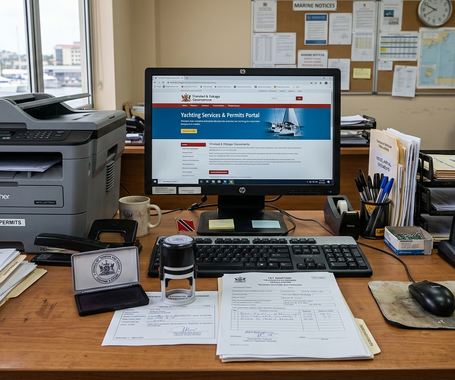
The workflow uses infrastructure already familiar to cruisers. Applications may be transmitted by VHF radio to the designated coordination frequency or filed through port authority offices and local marina channels. The system does not depend on a special app or a private network.
A typical radio sequence begins with an initial hail on VHF Channel 16. Once contact is established, the vessel shifts to a designated working channel such as 68 or 69 for details that should not clutter the distress and calling channel. Radio discipline matters here; a long, unfocused Channel 16 exchange is poor practice and makes every other station wait.
Basic submission sequence
- Confirm vessel clearance status and crew manifest before initiating the request.
- Contact the designated coordination point by VHF or through the port authority office.
- Provide vessel particulars, intended departure time, crew details, and communications capability.
- Await confirmation receipt and any request for corrected documentation.
- Receive the assigned convoy slot and updated weather briefing.
- Monitor for amendments before the cutoff window.
Final convoy slot assignments and weather briefings are typically broadcast between 08:00 and 09:30 AST on the morning of departure. That morning broadcast is not a formality. It is where the paper request meets actual operating conditions: squall lines, sea state, route timing, and the number of vessels that are actually ready to move.
Amendments require re-submission prior to the cutoff window. A crew change, a delayed clearance, or a failed radio check can alter the group picture enough to require a fresh review. In my comparisons of regional safety frameworks, the strongest procedures are the ones that make amendment rules explicit before the docklines come off.
Caution: VHF range is not fixed. Atmospheric ducting and the height of the vessel's masthead antenna can change who hears whom, so a boat that copied the morning broadcast clearly may still struggle to hold contact later in the passage.
Operational Execution and Limits
Once underway, the convoy becomes a radio and formation problem. Participating yachts maintain prescribed spacing, hold continuous radio watch, and keep the fleet compact enough for monitoring without creating collision risk.
Tactical commanders set formation spacing at 0.5 to 1.5 nautical miles between participating yachts. That range gives room for watchkeepers to manage sail trim, engine speed, squalls, and traffic avoidance, while still keeping the group visible as a coordinated movement. Too tight, and yachts create unnecessary close-quarters risk. Too loose, and the convoy stops functioning as a convoy.
Radio watch and formation discipline
- Maintain continuous dual-watch monitoring on VHF Channel 16 and the assigned inter-ship working frequency.
- Use DSC for structured contact where appropriate, especially during initial fleet synchronization.
- Report speed reductions, gear failure, or crew illness early rather than waiting until separation becomes obvious.
- Keep navigation lights, AIS if fitted, and lookout routines aligned with normal collision-avoidance practice.
- Do not assume another yacht has heard an instruction unless it acknowledges the call.
Radio coverage is not a security perimeter. It is a coordination tool, and it performs best when every participating skipper treats concise reporting as part of seamanship.
The hard limit is jurisdictional. Official Coast Guard escort and direct intervention capabilities terminate at the 12-nautical-mile territorial water boundary. Beyond that line, vessels still benefit from mutual fleet support, shared situational awareness, and EPIRB activation protocols, but the legal and tactical character of assistance changes.
Expert Tip: Before departure, agree on what the group will do if one vessel slows below convoy speed. The answer should be known before midnight, not improvised when the masthead lights are already separating.
That boundary is the number skippers should keep in mind when judging what a convoy request can and cannot do: direct intervention ends at the 12-nautical-mile territorial water boundary.