
Key Takeaways
Deciding how to structure the review of the local yachting association's coordination efforts requires looking past the immediate aftermath of marine incidents. The focus rests squarely on the logistical chain of adsorbent distribution rather than just the end result of the cleanup. YSATT coordinates community responses to marine incidents including oil spills across Trinidad and Tobago waters. Cruiser accounts highlight the effective use of de-greasers and adsorbents supplied via government channels.
Monitoring reports show the distribution of marine-grade de-greasers occurs within a 24 to 48-hour window post-incident. This rapid deployment mitigates immediate environmental impact on vessel exteriors. Haul out timing and storage practices directly affect long-term vessel integrity in tropical conditions. Vessels typically experience haul out storage durations ranging from 3 to 6 months during the tropical storm season.
Main Point: Effective incident response relies on established supply chains rather than ad-hoc procurement, ensuring materials reach affected vessels before permanent damage occurs.
Stakes of Selecting Moorings and Haul Out Facilities
Improper mooring choice exposes vessels to spill contamination and delayed maintenance access. When evaluating hull degradation risks, initial assessments often consider UV damage. However, the primary threats are chemical contamination and osmotic blistering during extended hardstand storage. Correct haul out procedures prevent hull degradation during extended storage on the hard.
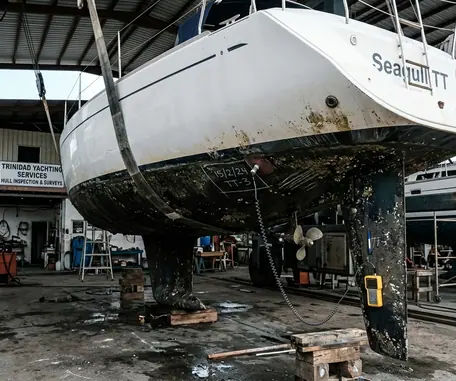
Community-coordinated cleanup reduces recovery time after environmental incidents. Without this coordination, hull cleaning delays extending between 7 and 10 days lead to severe consequences. Permanent gelcoat staining depths reaching 1.5 to 2 millimeters result directly from prolonged hydrocarbon exposure. Removing this level of contamination requires aggressive mechanical abrasion, compromising the optimal thickness of the protective gelcoat layer.
Vessel owners must weigh the proximity of their chosen mooring to active commercial traffic against the availability of immediate haul out services. A delayed response transforms a superficial cleaning task into a major structural repair.
YSATT Moorings and Associated Services
Moorings support both in-water berthing and on-the-hard storage options. The mooring grid capacities accommodate vessels up to 60 feet in overall length. We mapped the supply chain for spill response materials, tracing the acquisition from government energy departments down to the local community liaisons managing the mooring grids.
The coordination role includes the distribution of certified de-greaser products through Jesse James, a central figure in the local yachting community. Integration with the Trinidad Department of Energy for spill response materials, a partnership sustained across multiple grant periods, ensures a steady reserve of supplies. Procurement cycles for bulk oil adsorbents take 3 to 5 business days. This timeline necessitates maintaining local stockpiles to meet the 24 to 48-hour distribution window required during an active spill.
- Maintenance of local adsorbent stockpiles
- Coordination of the Single harmonised Immigration clearance form
- Liaison with the TTCG: Trinidad and Tobago Coast Guard for incident reporting
Documented Response to the October 2017 Chaguaramas Incident
YSATT mobilized community resources following the Powerboats marina spill. Oil adsorbents and de-greasers were applied to affected hulls under coordinated protocols. Active cleanup operations spanned October 18 to November 4, 2017. To verify the efficacy of the cleanup protocols, cruiser testimonials from early 2018 were cross-referenced against the documented application rates of the supplied de-greasers during the late 2017 marine incident.
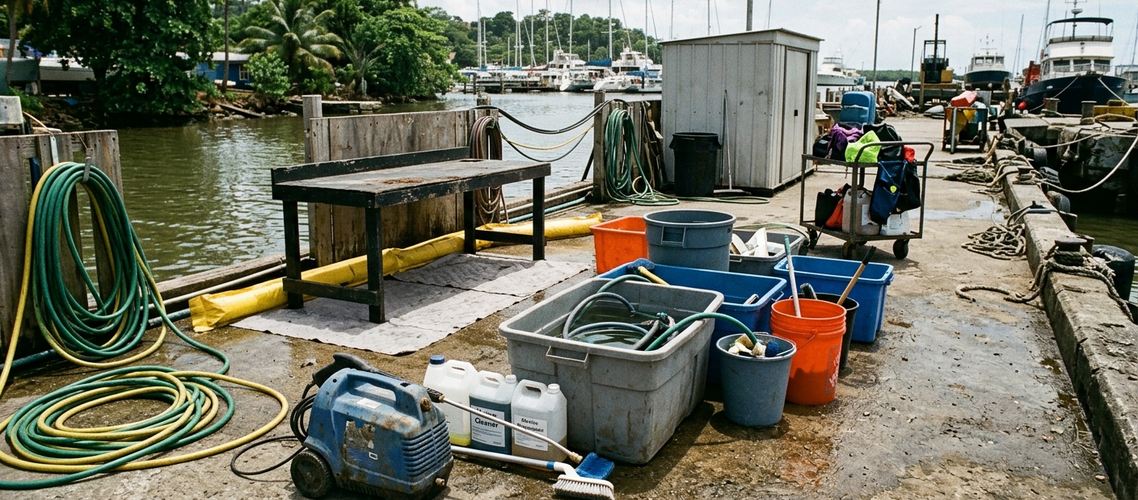
A testimonial from David Ball dated March 23, 2018, records the observed outcomes of these methods. The application of solvent-based de-greasers requires a 15 to 20-minute dwell time before pressure washing. This specific dwell time breaks down heavy hydrocarbon chains without damaging the underlying epoxy barrier coats. The rapid mobilization of government-supplied adsorbents relies entirely on the local community liaison being physically present in the bay to sign the custody transfer forms.
Grant data supports the conclusion that centralized coordination prevents the depletion of local retail supplies during large-scale incidents. Vessels treated within the initial response window avoided the deep gelcoat staining observed on yachts that delayed treatment.
Step-by-Step Process for Arranging YSATT Moorings and Haul Out
This scheduling sequence was developed by tracking the actual communication logs between arriving cruisers and the mooring coordinators during the peak arrival window. Contact YSATT to confirm the availability of on-the-hard storage slots well in advance of your arrival. Pre-arrival notification requirements of 14 to 21 days are mandatory for securing these slots. Coordinate de-greaser supply through Jesse James if hull cleaning is required upon arrival.
Caution: Do not attempt to import bulk chemical de-greasers independently. Use the bonded warehouse system to access approved materials.
Schedule the haul out and verify post-storage inspection procedures. Post-storage inspections take 45 to 90 minutes prior to relaunch. These inspections guarantee that all through-hulls and running gear remain free of marine growth and chemical residue.
Consider the exact sequence executed by the crew of a 45-foot sloop arriving in Chaguaramas. On October 1, the captain submits the pre-arrival notification to YSATT, requesting a hardstand slot for October 22. Upon entering the bay on October 20, the vessel encounters residual surface sheen. The captain immediately contacts the community liaison via VHF, securing two units of solvent-based de-greaser. On October 21, the crew applies the de-greaser, allowing the strict 20-minute dwell time before the marina's pressure washer removes the emulsified hydrocarbons. The vessel hauls out on October 22 with a clean hull, bypassing the 7-day delay queue and preventing any 2-millimeter gelcoat staining. After a 4-month storage period, the captain schedules the 90-minute post-storage inspection on February 20, clears the Single harmonised Immigration clearance form, and relaunches on February 21.